

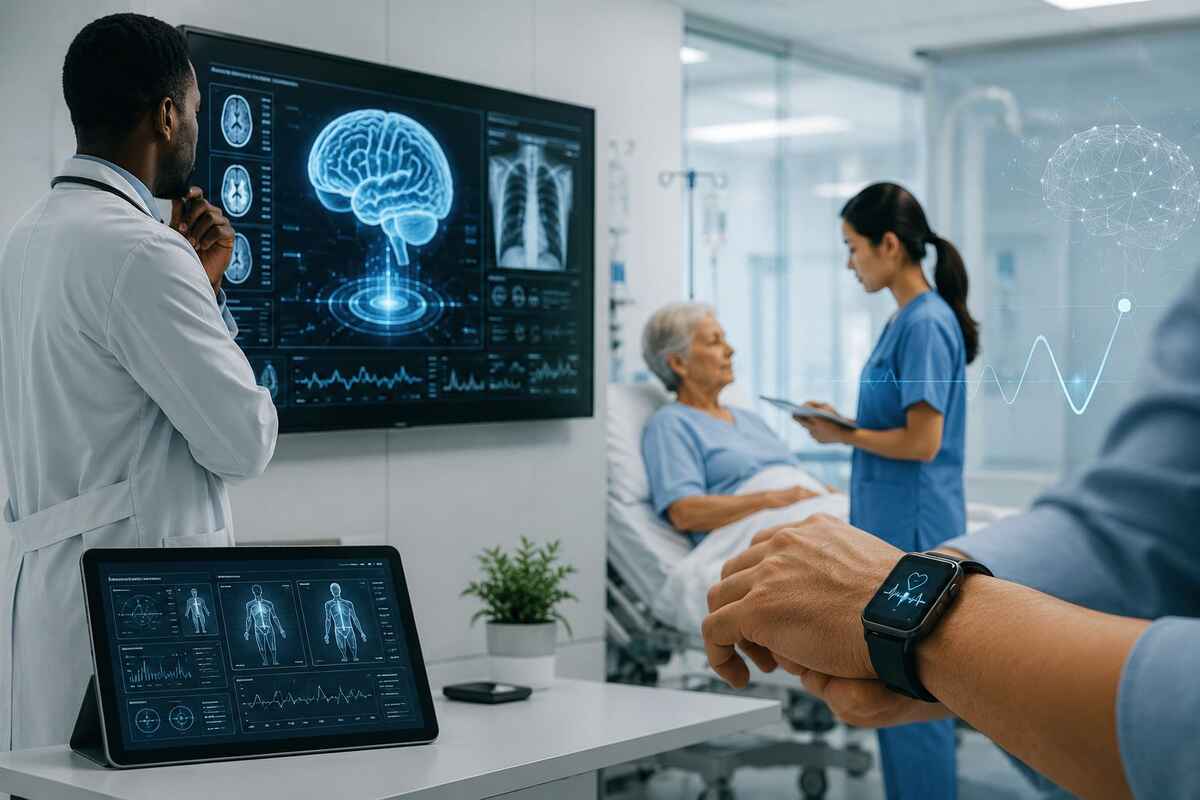
A few years ago, the idea of a computer catching a tumor before a radiologist did sounded like science fiction. Today, it’s just Tuesday at a growing number of hospitals. AI in healthcare has quietly moved from research labs into emergency rooms, radiology departments, and even the apps patients use to check their symptoms at 2 a.m.
This shift isn’t about robots replacing doctors — despite what headlines love to suggest. It’s about something more practical: giving overworked clinicians better tools, catching problems earlier, and making the entire patient experience feel less like a maze. In this article, we’ll walk through exactly how AI in healthcare is changing patient care right now, which hospitals are already using it, and what the honest risks and limitations look like too.
What Is AI in Healthcare and Why It Matters Now
At its core, AI in healthcare refers to computer systems that can analyze medical data, spot patterns, and support decisions in ways that would take humans much longer to do manually — or that humans might miss entirely.
This isn’t one single technology. It’s a mix of tools working together:
- Machine learning models trained on millions of medical images or patient records
- Natural language processing that reads and organizes clinical notes
- Predictive analytics that flag patients at risk before symptoms fully appear
- Automation tools that handle scheduling, billing, and administrative tasks
This isn’t just theoretical, either. The FDA’s list of AI and machine learning-enabled medical devices now includes well over 1,400 authorized tools already in clinical use across imaging, diagnostics, and patient monitoring — proof that this shift is already well underway, not something still confined to research labs.
Why does this matter now specifically? Because healthcare systems are stretched thin. Staff shortages, rising patient volumes, and mounting paperwork have pushed many hospitals to a breaking point. AI isn’t a magic fix, but it’s proving to be one of the few tools that can meaningfully reduce that pressure while improving outcomes at the same time — which is a rare combination in healthcare innovation.
How Artificial Intelligence Improves Disease Diagnosis
Diagnosis is where AI in healthcare has made some of its most measurable progress. The technology is particularly good at one thing: spotting subtle patterns across huge amounts of data faster than a human ever could.
Predictive models are now being used to flag early warning signs of conditions like sepsis, kidney failure, and certain cancers — often before a patient shows obvious symptoms. Instead of waiting for a crisis, care teams can intervene earlier, when treatment tends to be simpler and more effective.
This doesn’t mean AI is diagnosing patients on its own. In nearly every real-world deployment, these systems work as a second set of eyes — flagging cases for a human specialist to review, rather than making the final call. That distinction matters both clinically and ethically, and it’s one reason regulators have been cautiously supportive of this kind of AI-assisted diagnosis rather than fully autonomous decision-making.
AI-Powered Medical Imaging: Catching What Doctors Might Miss
Medical imaging is arguably the clearest success story for AI in healthcare so far. Radiologists review enormous volumes of scans daily, and fatigue is a real, well-documented factor in missed findings — not from lack of skill, but simply from the sheer volume of images a single person has to interpret.
AI imaging tools are trained on massive datasets of X-rays, MRIs, and CT scans, which allows them to detect subtle abnormalities — a barely visible nodule, an early-stage tumor, a hairline fracture — that can be easy to overlook under time pressure.
In practice, this has translated into real efficiency gains. Some AI-assisted radiology workflows have cut the time it takes to flag critical scan results nearly in half compared to traditional review processes. For a patient with a stroke or a fast-growing tumor, that kind of speed can directly affect outcomes.
Cardiology has seen similar gains, with AI models now assisting in reading echocardiograms and flagging heart function abnormalities that support faster, more confident specialist review.
Personalized Treatment Plans Powered by Machine Learning
Not every patient responds to treatment the same way — something doctors have always known but haven’t always had the data to act on precisely. This is where machine learning is starting to change the equation.
By analyzing a patient’s full health picture — genetics, past treatment history, lab results, and even data from wearable devices — AI models can help predict which treatments are more likely to work for a specific person, rather than relying purely on population-wide averages.
This is especially valuable in fields like oncology, where treatment side effects can be severe and time matters. AI-assisted tools can help oncologists narrow down options faster, reducing the trial-and-error period that used to be standard practice.
It’s worth being clear here: this is decision support, not decision replacement. The oncologist, cardiologist, or primary care physician still makes the final call — AI simply gives them a more complete picture to work from.
Smarter Patient Experience: Chatbots, Wait Times, and Access
Not all of AI’s impact happens in the operating room or the lab. A lot of it happens in the everyday friction points patients deal with constantly — long hold times, confusing scheduling systems, and delayed responses to simple questions.
AI-powered chatbots and virtual assistants are increasingly handling the first layer of patient interaction:
- Answering common questions about symptoms, medications, or appointment prep
- Helping patients book, reschedule, or confirm appointments without a phone call
- Triaging non-urgent concerns so human staff can focus on complex cases
This has a real downstream effect. Missed appointments cost the U.S. healthcare system an enormous amount every year, and predictive AI tools that identify which patients are likely to no-show allow clinics to intervene proactively — with a reminder call or a rescheduled slot — instead of losing that appointment slot entirely.
For patients, the experience simply feels smoother. Fewer dead-end phone calls. Faster answers. Less waiting for things that shouldn’t require waiting.
Remote Monitoring and Wearable Tech in Modern Care
Healthcare used to be something that happened almost entirely inside a hospital or clinic. AI is helping shift some of that care into patients’ everyday lives — safely and continuously.
Wearable devices now track heart rate variability, blood oxygen levels, glucose trends, and sleep patterns, feeding that data into AI systems that watch for early warning signs of trouble. For patients managing chronic conditions like diabetes or heart disease, this kind of continuous monitoring can catch problems days before they’d otherwise become an emergency room visit.
Hospitals have taken this further with virtual monitoring centers, where centralized teams use AI-assisted camera and sensor systems to watch for early signs of complications like sepsis across dozens of hospital beds simultaneously — extending the reach of a limited nursing staff without compromising attentiveness.
This is one of the more underrated shifts in AI in healthcare: care that doesn’t stop at the hospital doors.
Supporting Doctors, Not Replacing Them: AI’s Real Role
It’s worth addressing this directly, because it’s the question most people actually have: is AI going to replace doctors?
The honest answer, based on how these tools are actually being deployed, is no — at least not in the way headlines imply. AI in healthcare today functions almost exclusively as clinical decision support. It flags, predicts, and suggests. Humans still diagnose, treat, and take responsibility for outcomes.
If anything, one of AI’s biggest real-world contributions has been reducing the administrative burden that pulls doctors away from patients in the first place. AI-powered documentation tools that transcribe and organize clinical notes during appointments have freed up meaningful chunks of physicians’ time — time that goes back into direct patient interaction instead of paperwork after hours.
That’s not a flashy headline, but it might be one of the most meaningful improvements to patient care that AI has delivered so far.
Real Hospitals Already Using AI in Healthcare Today
This isn’t theoretical. Major health systems have moved well past small pilot programs and into full operational use.
Several leading academic medical centers now use AI extensively across diagnostics and research, with some ranking among the most AI-mature health systems in the country based on adoption depth and patented AI tools. Partnerships between hospitals and specialized AI companies have also strengthened diagnostic accuracy in pathology, helping catch abnormalities in tissue samples that are easy to miss under standard review conditions.
Documentation is another area of major traction. At several large health systems, the vast majority of physicians using AI-powered documentation tools report high satisfaction, with many saving significant time each day that previously went to manual note-taking.
On the monitoring side, some hospital networks now use centralized, AI-assisted virtual care centers to watch thousands of hospital beds at once for early signs of complications like sepsis — extending expert-level attentiveness across multiple facilities simultaneously.
At scale, some larger hospital systems now run hundreds of active AI tools across their networks, spanning everything from automated clinical notetaking to sepsis surveillance, generating measurable financial and clinical value in the process.
The common thread across all of these examples isn’t experimentation for its own sake. It’s AI being pointed at specific, high-friction problems — missed diagnoses, burnout, understaffed monitoring, slow imaging turnaround — and quietly fixing them.
Risks, Bias, and Privacy Concerns Worth Understanding
No honest article about AI in healthcare would leave this part out. The technology brings real benefits, but it isn’t without meaningful risks.
Algorithmic bias is one of the most serious concerns. If an AI model is trained mostly on data from one demographic group, it can perform less accurately for patients outside that group — potentially widening existing healthcare disparities instead of closing them.
Data privacy is another major issue. AI systems rely on large volumes of sensitive patient data, which makes strong security practices non-negotiable. Reputable healthcare AI tools are built around strict compliance standards, encrypted data handling, and clear audit trails — but not every vendor meets that bar equally well.
Over-reliance is a subtler risk. AI tools are designed to support clinical judgment, not override it. When systems are treated as infallible rather than as one input among many, mistakes can slip through more easily, not less.
None of this means AI in healthcare should be avoided — it means it should be adopted carefully, with human oversight built in as a permanent feature, not a temporary safeguard during rollout.
What the Future of AI in Healthcare Means for Patients
Looking ahead, the trajectory is fairly clear: AI in healthcare is moving from isolated tools toward fully integrated systems that touch nearly every part of the patient journey — from the first symptom check to long-term chronic disease management.
For patients, this likely means:
- Faster diagnosis and fewer missed early warning signs
- Treatment plans that are more tailored to individual health data
- Less time spent on hold, waiting, or navigating confusing systems
- Continuous, AI-assisted monitoring that catches problems before they escalate
The technology will keep advancing, but the underlying goal isn’t changing — using AI to give clinicians more time, more insight, and more capacity to focus on the human side of medicine.
FAQs
Is AI safe to use in healthcare?
Generally, yes — when used by reputable providers following strict compliance and security standards. AI tools in healthcare typically operate under regulations like HIPAA, with encrypted data handling and human oversight built into how they’re used.
Can AI replace my doctor?
No. AI in healthcare is designed to support clinical decision-making, not replace it. Doctors still review AI-generated insights and make the final call on diagnosis and treatment.
What are real examples of AI in patient care today?
Common examples include AI-assisted medical imaging analysis, predictive tools for early disease detection, AI documentation assistants, remote patient monitoring, and chatbots that handle scheduling and basic patient questions.
How is patient data protected when AI is used?
Reputable healthcare AI systems operate within strict compliance frameworks, including data encryption, access controls, and regular security audits, to keep protected health information secure.
Will AI in healthcare get more common in the coming years?
Yes. Adoption has grown rapidly, with hospitals expanding AI use across diagnostics, documentation, and patient monitoring — a trend expected to continue as the technology matures and proves its value.
Final Thoughts
AI in healthcare isn’t a distant, futuristic concept anymore — it’s already reshaping how diagnoses happen, how treatment plans get built, and how patients experience care day to day. From imaging tools that catch what tired eyes might miss, to virtual monitoring systems that extend a hospital’s reach, the technology is solving real, specific problems rather than chasing hype.
It’s not perfect, and it’s not meant to operate without human judgment. But used thoughtfully, AI in healthcare is giving doctors more time, patients more attention, and the entire system a better shot at catching problems early — which, at the end of the day, is what better patient care has always been about.