
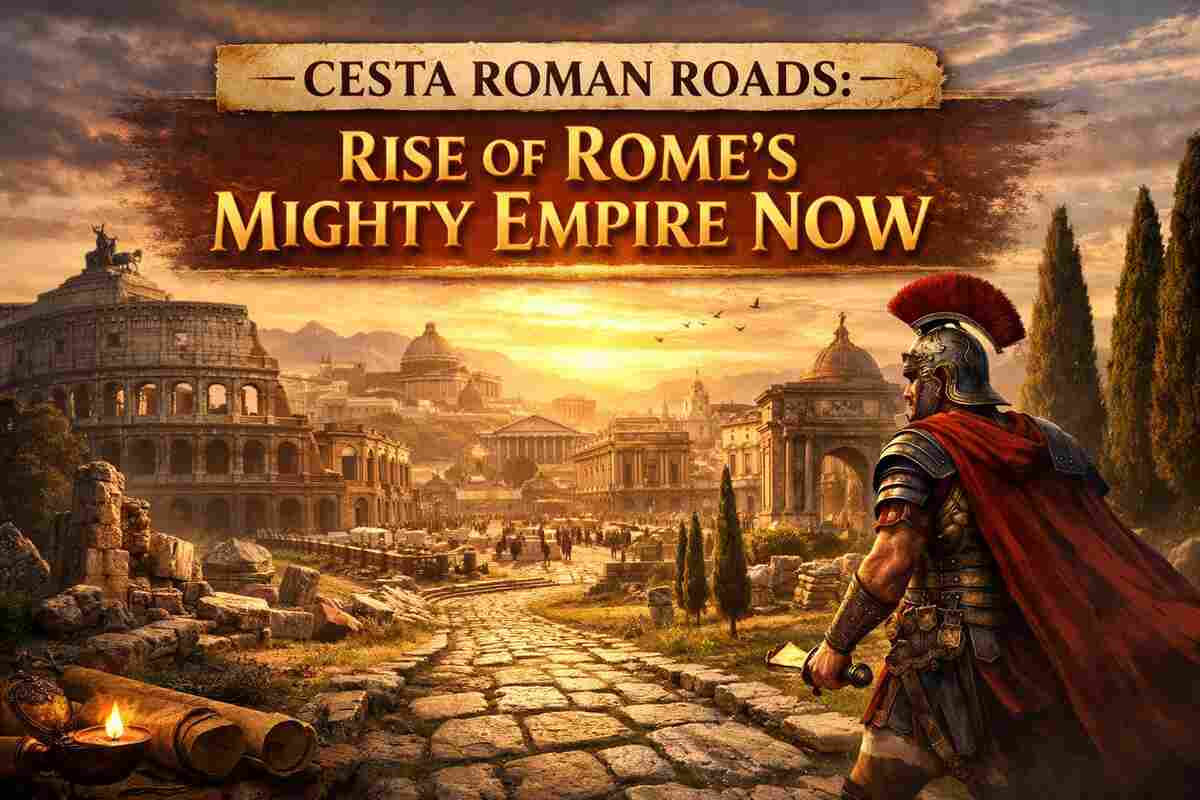
Cesta Roman wasn’t just a collection of paths—it was the lifeline that turned a small Italian city into the ruler of the ancient world. Picture an empire stretching from misty British hills to the sun-baked deserts of North Africa, all stitched together by thousands of kilometers of smartly built roads. These weren’t bumpy dirt tracks worn down by feet. Cesta Roman stood for something far bigger: engineered highways designed for speed, strength, and connection.
In this guide, we’ll unpack the full story behind Cesta Roman, from its humble military beginnings to its role in trade, culture, and even today’s highways. Whether you’re new to Roman history or a longtime fan, you’ll see how these roads did more than move people—they built, held, and inspired one of history’s greatest powers. Let’s dive in and discover why infrastructure truly made the empire.
What Is Cesta Roman? The Ancient Roman Road Network Explained
Cesta Roman simply means “Roman road” or “constructed way.” Unlike random trails that formed over time, these were carefully planned routes built by the state to link cities, forts, and ports across three continents. At its height, the network covered around 300,000 kilometers—recent mapping efforts like the 2025 Itiner-e project doubled earlier guesses by uncovering countless smaller connecting paths.
The genius lay in their purpose. Cesta Roman turned distant lands into one unified system. Messengers, soldiers, merchants, and officials could travel reliably, no matter the weather or terrain. This wasn’t luxury travel; it was practical power. Every milestone and straight stretch reminded people who was in charge while making daily life smoother for everyone under Roman rule.
Origins of Cesta Roman: How It All Began
The story kicks off in 312 BC with the Via Appia, ordered by a Roman official named Appius Claudius Caecus. At first, it was a smart military move to connect Rome with Capua during tough wars in southern Italy. What started as one vital link soon grew into a sprawling web as the Republic became an empire.
As Rome expanded, so did its roads. Emperors poured resources into new routes, and legions often built them while conquering. Local governors adapted older paths where it made sense, blending them into the bigger plan. Over centuries, this phased growth mirrored Rome’s rise—each new road pulled far-flung provinces closer to the capital and turned conquest into lasting control.
Engineering Marvels of Cesta Roman Roads
Roman builders approached every project with military precision. They used simple tools like the groma for straight lines and the chorobates for perfect leveling. First came site clearing, then a deep trench for stability. The real magic happened in the layers stacked on top.
Here’s how they did it, step by step:
- Foundation layer: Large stones created a solid base.
- Middle layers: Crushed rock mixed with lime for strength and drainage.
- Top surface: Smooth, fitted paving stones with a slight curve (camber) so rainwater ran off into ditches.
- Materials: They used whatever was local—volcanic ash in Italy for extra-tough concrete-like binds.
This smart design let roads handle heavy carts, marching troops, and centuries of use. Many stretches still exist today, proving the focus on quality over shortcuts.
Iconic Cesta Roman Routes Across the Empire
Some roads became legends in their own right. The Via Appia, nicknamed the “Queen of Roads,” stretched from Rome all the way to Brindisi on the coast, serving as a lifeline for armies and traders alike. Other standouts included the Via Flaminia heading north and the Via Aurelia hugging the western shoreline.
Across the empire, routes like the Via Egnatia bridged Europe and Asia, while the Via Augusta helped tame Spain. Milestones popped up every Roman mile to guide travelers, and junctions often sparked new towns. These famous arteries weren’t just lines on a map—they wove the empire’s story, connecting people, goods, and ambitions from Britain to the Middle East.
Cesta Roman Roads and Roman Military Power
Cesta Roman gave Roman legions a massive edge on the battlefield. Troops could cover up to 30 kilometers a day with supplies arriving on time, letting commanders strike fast or reinforce weak spots before trouble spread. The famous cursus publicus relay system meant important messages raced across the empire in days instead of months.
Beyond fighting, these roads kept the peace. Governors patrolled provinces easily, and the sight of a well-maintained highway reminded everyone of Rome’s reach. Soldiers even helped build and repair them, blending military discipline with engineering know-how. In short, Cesta Roman turned distance from a weakness into a weapon of control.
How Cesta Roman Boosted Trade and Economy
Safe, predictable roads changed commerce forever. Merchants could plan trips accurately, shipping everything from Spanish olive oil to Egyptian grain with lower risks and costs. Taxes collected at key points funded even more construction, creating a positive loop of growth.
New settlements popped up at crossroads, markets buzzed, and regions specialized in what they did best. The network supported massive trade volumes that enriched both the capital and the provinces. For everyday people, it meant better access to goods, jobs, and opportunities—proof that smart roads could fuel long-term wealth for an entire empire.
Cultural Impact of the Cesta Roman Network
Travel along Cesta Roman wasn’t only about business or war. It carried ideas, languages, and customs far and wide. Officials, pilgrims, and families mixed at rest stops, sharing stories and skills that slowly created a shared Roman identity.
Latin spread along these routes, as did Roman laws, building styles, and even early Christianity. Inscriptions on milestones reinforced the empire’s message while local flavors added richness. The network turned scattered communities into part of something bigger—a connected world where knowledge flowed as freely as carts and soldiers.
Modern Legacy of Cesta Roman Roads Today
Walk through parts of Europe today and you’ll often follow the exact same lines the Romans laid down centuries ago. Cities like London and Paris still sit where ancient junctions once thrived, and many highways trace old alignments for efficiency.
The 2025 Itiner-e mapping project continues revealing hidden sections, inspiring modern engineers with lessons on drainage, durability, and smart planning. Tourists flock to preserved stretches like the Appian Way, learning history while enjoying scenic walks. Cesta Roman shows us that great infrastructure doesn’t just serve its time—it shapes the future.
For More Blogs Visit Trend Fables.
Conclusion
Cesta Roman proved that roads could do more than connect places—they could create and sustain an empire. From military victories to economic booms and cultural blending, this network embodied Roman vision and grit. Its lessons on quality, foresight, and adaptability still matter in our connected world.
If this dive into ancient engineering sparked your curiosity, why not explore more Roman wonders or even plan a trip along a surviving route? Drop a comment below with your favorite fact or road you’d love to walk someday—we’d love to hear from you!